 Spark Prime Network blog news
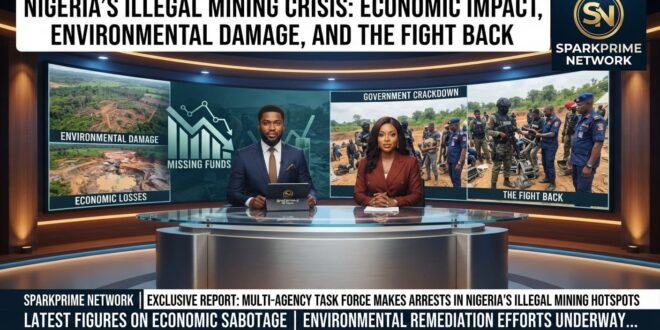
Nigeria is blessed with vast solid mineral resources, spanning gold, lithium, coal, limestone, and tin across multiple regions. However, the abundance of these resources has a dark side. Unregulated and unauthorized extraction has birthed a massive illegal mining economy, robbing the country of billions of dollars, destroying local ecosystems, and fueling insecurity.
Whether you are looking up data for research, tracking law enforcement crackdowns, or trying to understand how illicit mining affects local communities, here is a complete breakdown of Nigeria’s illegal mining crisis and what is being done to stop it.
1. The Scale of the Problem: Why is Nigeria illegal mining crisis Thriving
While the Federal Government holds legal ownership and control over the country’s mineral resources under the Nigerian Minerals and Mining Act, a staggering amount of extraction happens entirely off the books.
Several factors drive this illicit trade:
-
Poverty and Unemployment: A lack of formal economic alternatives drives vulnerable populations into artisanal and unauthorized mining just to survive.
-
Lucrative Global Markets: High demand for minerals like gold and industrial components makes illicit extraction extremely profitable for unauthorized syndicates.
-
Weak Enforcement and Corruption: Past gaps in inter-agency collaboration and porous borders have allowed unauthorized operators both local and foreign to exploit remote regions unchecked.
2. Devastating Consequences: Economy, Environment, and Security
The impacts of unmitigated illegal mining stretch far beyond missing government revenue:
-
Massive Economic Losses: Nigeria loses billions of naira annually in unpaid royalties, taxes, and unrecorded mineral exports.
-
Severe Environmental Degradation: Unregulated excavation causes widespread deforestation, soil erosion, the creation of dangerous open sinkholes, and heavy chemical pollution of rivers and groundwater sources using toxic agents like mercury and cyanide.
-
Links to Insecurity and Banditry: Security reports and international bodies have repeatedly highlighted dangerous overlaps between illegal mining operations, illicit financial flows, and rural banditry or terrorism financing in parts of the North-West and North-Central regions.
3. Recent Crackdowns: Government and Security Responses on Nigeria illegal mining crisis
In response to these multi-layered threats, security and regulatory agencies have intensified operations to sanitize the solid minerals sector:
-
The Mining Marshals Initiative: Specialized enforcement teams, such as the NSCDC Mining Marshals, have been deployed to crack down on unauthorized operators and enforce compliance with the Nigerian Minerals and Mining Act.
-
Inter-Agency Operations: Joint sweeps by the military and specialized civil defense corps continue to yield arrests. For instance, recent routine military operations by the Nigerian Army in areas like Izom, Niger State, resulted in the apprehension of unauthorized operators and the seizure of operational equipment and cash, which were subsequently handed over for prosecution.
-
International Collaboration: Global entities like the United Nations Office on Drugs and Crime (UNODC) are increasingly partnering with Nigerian security architecture to cut off the nexus between illicit mining and organized crime.
The Path Forward: Reclaiming Nigeria’s solid minerals sector requires a combination of strict intelligence-driven enforcement, formalizing artisanal miners into cooperatives, and sealing security loopholes to ensure that natural wealth actually contributes to national development.
watch the video.
-
FG Intensifies Crackdown on Illegal Mining with New NSCDC Gun Trucks – A report highlighting the deployment of specialized equipment and the ongoing security operations against unauthorized mining.
-
Illegal Mining Crackdown: We Are Not Ready to Develop Our Mining Sector ─ Enaholo Ojiefoh – An expert analysis on the challenges involved in reforming and developing Nigeria’s formal mining sector.
-
405 Arrests, 64 Illegal Sites: Mining Marshal Marks 1 Year of Crackdown & Compliance Drive – A look at the achievements and ongoing activities of the Mining Marshals in their enforcement efforts.