 Spark Prime Network blog news
Throughout history, scientific discoveries have transformed civilization. The invention of the wheel revolutionized transportation. The discovery of electricity powered the modern world. Antibiotics saved millions of lives, and the internet reshaped communication forever.
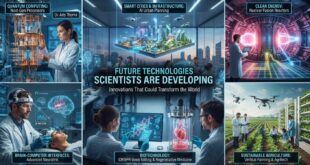
Today, humanity stands on the edge of another era of extraordinary discovery. Rapid advances in artificial intelligence, biotechnology, quantum computing, renewable energy, robotics, and space exploration are opening doors that previous generations could only imagine.
Scientists around the world are working to answer some of the biggest questions ever asked:
- Are humans alone in the universe
- Can every disease be cured
- Is unlimited clean energy possible
- Can people live on another planet
- What is dark matter
- How did life begin
- Can aging be slowed or even reversed
By 2050, researchers hope to solve many of these mysteries. While no one can predict the future with certainty, current scientific progress suggests that the coming decades could produce discoveries unlike anything in human history.
Why 2050 Could Be a Historic Milestone
Scientific progress has accelerated dramatically over the last century.
In the early 1900s, airplanes were experimental.
Today, reusable rockets carry satellites into space almost routinely.
Computers once filled entire buildings.
Now smartphones contain more computing power than the systems used during the first crewed Moon missions.
Several factors are driving this unprecedented pace of discovery:
- Artificial intelligence
- Supercomputers
- Global scientific collaboration
- Advanced robotics
- Genome sequencing
- Space telescopes
- Quantum technologies
- Big data analysis
These innovations allow researchers to solve problems much faster than ever before.
1. Discovering Life Beyond Earth
Perhaps the greatest scientific discovery would be proving that life exists somewhere else in the universe.
Scientists are searching for evidence in several places:
Mars
Future missions aim to return Martian rock samples to Earth, where laboratories can analyze them for signs of ancient microbial life.
Europa
One of Jupiter’s moons hides a vast ocean beneath its icy surface.
Many scientists believe this ocean could contain simple life forms.
Enceladus
Saturn’s moon ejects water vapor into space.
These plumes contain organic molecules, making Enceladus one of the most promising places to search for extraterrestrial life.
Exoplanets
Powerful telescopes are studying planets orbiting distant stars.
Scientists hope to detect atmospheric gases such as oxygen and methane in combinations that may indicate biological activity.
Why This Discovery Would Matter
Finding even microscopic alien organisms would completely transform biology, astronomy, religion, and philosophy.
It would prove that life is not unique to Earth.
2. Unlocking Unlimited Clean Energy
One of humanity’s biggest challenges is producing enough energy without damaging the environment.
Scientists hope nuclear fusion will become a practical source of electricity before 2050.
Unlike traditional nuclear power, fusion:
- Produces no greenhouse gases during operation
- Generates far less long-lived radioactive waste
- Uses abundant fuel sources
- Could provide enormous amounts of energy
Fusion mimics the process that powers the Sun.
If successfully commercialized, it could revolutionize the global energy system.
3. Curing Diseases That Have No Cure Today
Medical science has made remarkable progress over the last century.
Researchers now believe many diseases once considered incurable may eventually become treatable—or even preventable.
Areas of intense research include:
- Alzheimer’s disease
- Parkinson’s disease
- Certain cancers
- Type 1 diabetes
- Rare genetic disorders
- Muscular dystrophy
- Sickle cell disease
Advances in gene editing, stem-cell therapy, and AI-assisted drug discovery could dramatically improve survival rates and quality of life.
4. Growing Replacement Organs
Millions of patients worldwide wait for organ transplants every year.
Scientists hope to eliminate donor shortages by growing replacement organs in laboratories.
Researchers are exploring:
- 3D-printed organs
- Lab-grown kidneys
- Artificial hearts
- Bioengineered lungs
- Stem-cell regeneration
Because these organs could be created from a patient’s own cells, the risk of rejection may be significantly reduced.
5. Slowing the Aging Process
Although aging is a natural part of life, scientists are studying the biological mechanisms behind it.
Researchers hope to discover ways to:
- Repair damaged DNA
- Regenerate aging tissues
- Improve cellular repair
- Delay age-related diseases
- Extend healthy lifespan
The goal is not simply to help people live longer but to help them remain healthier as they age.
6. Understanding Dark Matter and Dark Energy
Every humans can see stars, planets, galaxies, and people accounts for only a small fraction of the universe.
Scientists estimate that most of the cosmos consists of:
- Dark matter
- Dark energy
These mysterious components cannot be observed directly, yet they influence the structure and expansion of the universe.
Future observatories and experiments may finally reveal their true nature.
7. Building Quantum Computers for Everyday Use
Quantum computers promise enormous computational power for specific types of problems.
By 2050, they could help:
- Discover new medicines
- Improve weather forecasting
- Optimize transportation
- Design advanced materials
- Strengthen cybersecurity
- Model complex biological systems
Rather than replacing traditional computers, quantum systems are expected to complement them in areas where classical computing struggles.
8. Permanent Human Settlements Beyond Earth
Scientists and engineers hope humanity will become a multi-planet species.
Potential milestones include:
- Long-term bases on the Moon
- Human missions to Mars
- Self-sustaining space habitats
- Advanced life-support systems
- In-space manufacturing
Such achievements would expand scientific research and improve technologies needed for deep-space exploration.
9. Discovering New Species on Earth
Even today, researchers continue to identify thousands of new species each year.
Many unexplored regions still hold biological surprises, including:
- Deep oceans
- Tropical rainforests
- Underground cave systems
- Polar environments
- Mountain ecosystems
Studying these species may lead to new medicines, sustainable materials, and a better understanding of biodiversity.
10. Artificial Intelligence as a Scientific Partner
AI is already helping scientists analyze enormous datasets, predict protein structures, and accelerate research.
By 2050, AI could assist in:
- Designing new drugs
- Monitoring climate change
- Managing smart cities
- Improving disaster response
- Advancing space exploration
- Discovering new materials
Rather than replacing scientists, AI is expected to become a powerful collaborator.
Challenges That Could Slow Discovery
Scientific progress is not guaranteed. Researchers face obstacles such as:
- Funding limitations
- Ethical concerns
- International conflicts
- Climate-related disruptions
- Cybersecurity threats
- Public mistrust of science
- Technical limitations
Overcoming these challenges will require global cooperation and sustained investment in education and research.
Why These Discoveries Matter
Future breakthroughs could:
- Improve global health
- Increase food security
- Reduce pollution
- Combat climate change
- Expand access to clean energy
- Create new industries
- Deepen our understanding of the universe
- Improve quality of life for billions of people
Scientific discovery benefits society not only through major breakthroughs but also through countless smaller advances that accumulate over time.
Looking Beyond 2050
While 2050 is an important milestone, scientific exploration will continue well beyond it. Future generations may witness discoveries that are difficult to imagine today, such as:
- Communication across vast distances in space
- New methods of sustainable resource production
- Advanced brain computer interfaces
- Greater understanding of consciousness
- Exploration of distant planetary systems
History shows that each generation builds upon the knowledge of the previous one, making tomorrow’s breakthroughs possible.
The coming decades promise to be among the most exciting periods in the history of science. From the search for life beyond Earth and the quest for practical fusion energy to advances in medicine, artificial intelligence, and space exploration, researchers are tackling challenges that could transform everyday life.
Although not every goal will be achieved by 2050, the pursuit of these discoveries drives innovation, inspires new generations of scientists, and expands humanity’s understanding of the world and the universe. Every experiment, observation, and breakthrough brings us one step closer to answering questions that have fascinated people for centuries.
Frequently Asked Questions
What is the biggest discovery scientists hope to make by 2050
Many consider the discovery of life beyond Earth or the successful commercialization of fusion energy to be among the most transformative possibilities.
Will all diseases be cured by 2050
It is unlikely that every disease will have a cure, but researchers expect significant progress in treating cancers, genetic disorders, and neurodegenerative diseases.
Could humans live on Mars by 2050
Scientists and space agencies aim to make human missions to Mars possible, though permanent settlements will depend on overcoming major technical and logistical challenges.
Why is artificial intelligence important for future discoveries
AI can process vast amounts of data, identify patterns, and accelerate research in fields such as medicine, climate science, chemistry, and astronomy.
How can young people contribute to future discoveries
By studying science, technology, engineering, mathematics, or related fields and by developing curiosity, critical thinking, and problem-solving skills young people can help shape the next generation of breakthroughs.